How Age Verification Technologies Adapt to Diverse Legal Frameworks in Sports Wagering Platforms

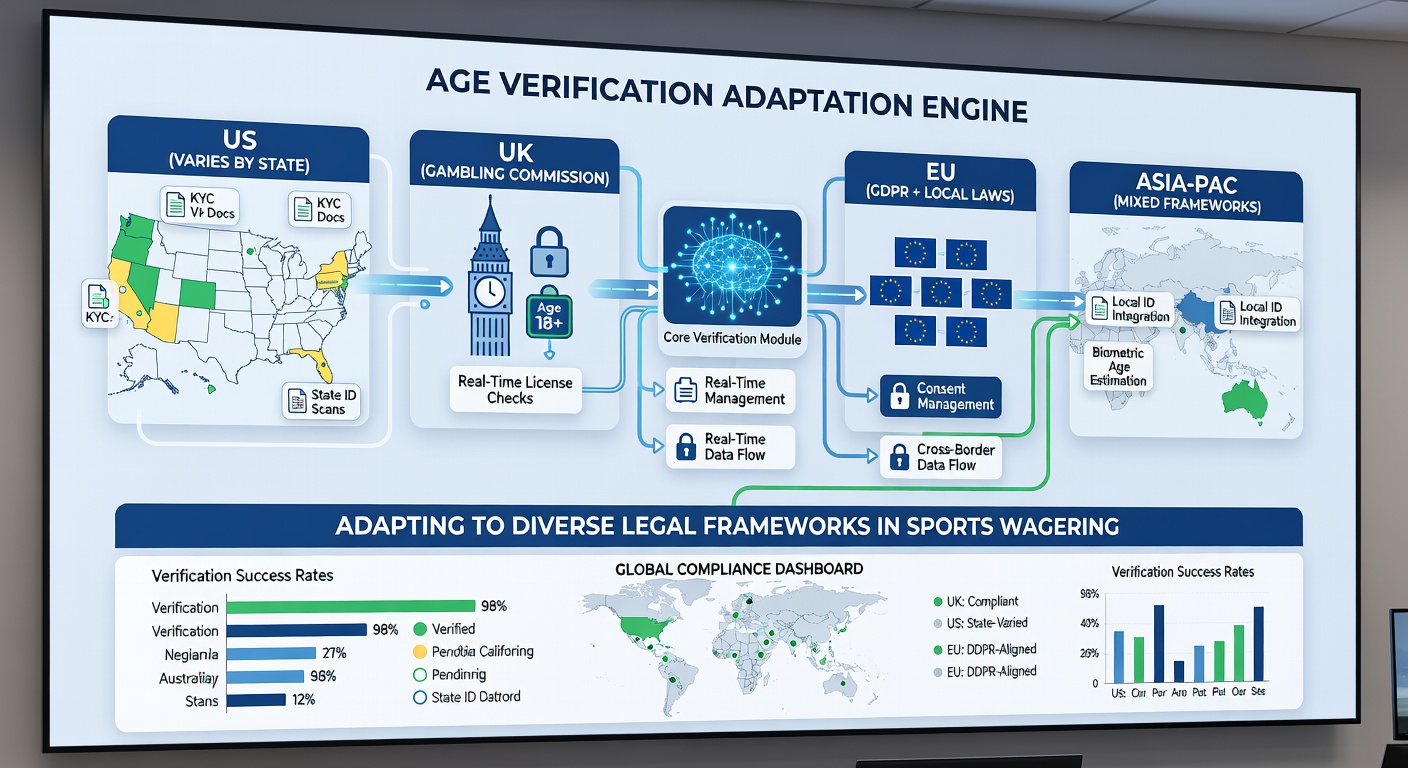
Age verification systems in sports wagering platforms must navigate a complex web of regulations that differ sharply by jurisdiction, and operators deploy modular technologies to meet those standards without disrupting user access. In the United States, where more than twenty states had legalized sports betting by May 2026, requirements range from strict 21-plus thresholds enforced through state gaming commissions to varying standards for identity document scanning and real-time database checks. Platforms integrate location-based triggers that activate different verification layers depending on the user's detected region, which allows a single app to comply with rules in New Jersey while adjusting protocols for markets like Colorado or Pennsylvania.
Regional Legal Variations Drive System Design
European frameworks emphasize data minimization under the General Data Protection Regulation, so verification tools there favor privacy-preserving methods such as tokenized identity proofs rather than full document storage. Canadian provinces apply their own licensing conditions that often combine government-issued photo ID with credit bureau cross-checks, prompting operators to build hybrid models that switch between biometric matching and manual review queues when automated scores fall below set thresholds. Australian state laws require verification before any deposit activity, which has led developers to embed instant passport or driver's license validation APIs that connect directly to national identity registries.
These differences force technology providers to maintain configurable rule engines that update automatically when legislation changes. One system deployed across multiple continents uses geofencing combined with regulatory databases to select the appropriate verification path within milliseconds of login, and this approach reduces compliance violations while maintaining consistent user experiences. Data from industry reports shows that platforms using such adaptive engines achieve faster onboarding times in jurisdictions with lighter requirements without compromising security in stricter markets.
Core Technologies and Their Flexible Implementations
Biometric facial recognition stands out as a widely adopted method because it can scale across legal environments when paired with liveness detection to prevent spoofing. In regions where privacy statutes limit persistent data retention, these tools process images in real time and discard raw footage immediately after generating a confidence score. Document scanning solutions incorporate optical character recognition trained on multiple international ID formats, allowing the same software to handle U.S. driver's licenses, European national identity cards, and Australian proof-of-age documents through jurisdiction-specific templates.
Blockchain-based verification has gained traction in markets seeking decentralized solutions, as it lets users present cryptographic proofs of age without revealing full personal details. European operators testing these methods report alignment with emerging digital identity standards, while certain U.S. state regulators have begun exploring pilot programs that integrate such proofs with existing licensing systems. Artificial intelligence models refine these processes continuously by analyzing verification success rates and flagging patterns that might indicate emerging compliance gaps.
Integration Challenges Across Borders
Operators face ongoing hurdles when users travel or access platforms from multiple locations, since a verification method acceptable in one jurisdiction may fall short in another. Solutions include storing only minimal metadata that satisfies the strictest applicable rule while allowing supplementary checks when needed. Research from academic institutions tracking digital identity adoption indicates that platforms investing in these layered systems experience fewer account suspensions related to age verification failures.
Updates rolled out in early 2026 incorporated new machine learning classifiers that better distinguish between valid and fraudulent submissions across diverse document types. Regulatory bodies in North America and Europe continue to issue guidance that shapes these technical adjustments, and platforms monitor official channels to implement changes ahead of enforcement deadlines.
Future-Proofing Verification Infrastructure
Collaboration between technology vendors and legal experts has produced standardized APIs that abstract away jurisdiction-specific details, which lets developers focus on core functionality rather than constant rewrites. These interfaces pull current rule sets from maintained regulatory repositories and apply them dynamically during each session. As sports wagering expands into additional markets through May 2026 and beyond, the ability to reconfigure verification flows without full system overhauls becomes essential for maintaining operational continuity.
According to National Conference of State Legislatures tracking, legislative activity around sports betting continues to evolve rapidly, which underscores the value of flexible verification architectures. Platforms that embed audit logging and real-time reporting features also satisfy oversight requirements in multiple regions simultaneously.
Conclusion
Age verification technologies succeed in sports wagering environments when they treat legal diversity as a design parameter rather than an obstacle. Modular architectures, privacy-focused biometrics, and automated regulatory mapping allow platforms to operate legally across borders while delivering reliable user experiences. Continued refinement of these systems will determine how effectively the industry scales as new frameworks emerge in coming years.